I am obsessed. I am mesmerised, enlightened and awed by a recently-discovered Chinese historical drama, the Legend of Miyue (芈月传).
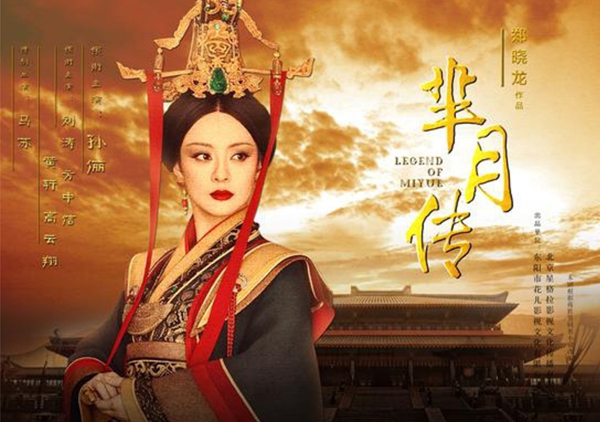
It tells the story of a remarkable woman, who used her smarts and kindness to overcome obstacles and evil plots and rise up to become… someone remarkable. I am still in the middle of the show, and love that this series has 80 glorious episodes for me to savour.
I love that the main character, Miyue, relies on her brains and I love that she is kind and brave and would not stay content with the cards she was dealt. But what leaves me in awe is the setting – the grand stories of the warring states era, which started around 475BC and did not end until 221BC when the Qin dynasty successfully unified the region to become the first Chinese empire.
It is a period that I am relatively less familiar with, as I grew up with stories and dramas set in the later Song/Ming/Qing dynasties. I was surprised to learn about the sophisticated military and diplomatic strategies that were deployed, and gaped in awe as I realised how intricate and advanced the societies were at that time; scholars vied for glory with their policy arguments; craftsmen pushed boundaries by improving product design; traders criss-crossed the land exchanging intricate goods and chase profit; mere foot soldiers rose to become generals with their military achievements.
The aspects of meritocracy and capitalism were startlingly familiar, and perhaps it is only proof of my own ignorance that I am surprised to see this from more than 2000 years ago. Inequality aside, the Chinese civilisation was actually pretty advanced.
As an ethnic Chinese, I feel kind of proud of that. Yet it also felt like it is a legacy that I have no claim to.
I am probably a forth or fifth generation Chinese from Malaysia. My ancestors, the ones who came to Malaya (as it was known then), likely came around 100 years ago to escape political strife in China. I do not know for sure, and I never asked, because I feel like I know that story. Stories of poverty and hardship and survival are, for the lack of a better word, pretty standard. They probably toiled daily to survive, and did not have the luxury to ponder and think about the future. My grandparents’ generation were mostly illiterate. My parents were among a small group of university-educated workers in their time, and they worked hard to build a middle-class lifestyle. I was blessed enough to live off that and build a life for myself in Singapore, enjoying the amenities that modern life offers.
The cultural traditions I grew up with were more or less behaviour-based: how to behave around elders, how to celebrate the various festivals and their origins. Teachers in my primary school loved mentioning that ‘the Chinese has 5000 years of grand culture’ in their bid to instill pride in our heritage.
Yet, growing up amid household chatter of happenings in the local market, some random office politics talk and an endless stream of TV (including many Chinese period dramas), the 5000 years of grand culture was perhaps tangible only via the TV. Even popular Chinese New Year songs that sang about spring added only distance – in my childhood there were no four seasons, only long hot afternoons that were either humid or wet with rain.
Who knew what it meant that trade and craftsmanship flourished in China back then? Who knew what a pity it was that such a powerful civilisation could fall into such disarray that her people escaped seeking a better life elsewhere? What did it mean that I could trace my ancestry back to a civilisation that was once so advanced? Should I be proud as my teachers would like me to be, or should I be sad?
I did not study classic Chinese texts or philosophies when I was growing up. Pragmatism generally rules among the Chinese diaspora – do what is needed to survive and thrive. Besides, we were busy enough trying to learn three languages – which brings me to the cultural heritage that I do have.
I am drawn to the grandeur of Chinese history and can be wistful about it, but it does not mean that I have no heritage to be proud of.
I lay claim to a different type of heritage – one of open-mindedness and adaptation, of staying attuned to opportunities and working hard for a better life. I grew up learning about not just Chinese anecdotes but also quirky Malay folktales and quaint English ones. I grew up watching not just Chinese period dramas but also Japanese animes, which I watched in not just Japanese with subtitles, but also versions dubbed English, Mandarin, Cantonese and Malay. Reading Harry Potter opened up my horizons to a whole new galaxy of stories from places far away. I also cannot imagine going without roti prata, kuih or pasta.
But I digress. I am not naive enough to wish that I had been born in an earlier time or a different place, I do love where I am right now and count my blessings every day. Sometimes it just feels like this quirky mix of heritage unique to this small corner of the world lacks some sort of grand historical narrative; that there are no shoulders of giants like 5000 years of history to stand on.
Only sometimes, though. Most of the time, I count myself lucky to grow up among such diversity; to know from young that there are people who look and act and talk differently but that we can live together regardless; to know that it is silly to stick to a suboptimal method just because it is ‘ours’, and to be open enough to adapt the better things for our own use.
My heritage is a legacy of open-mindedness and adaptation, and I’m sure more and more people across the world will share this as globalisation continues to shape this era. I have already met many wonderful people from across the world with whom I share this in common, and I am hopeful that this means we could all learn from each other.
This may sound naive in the light of rising nationalism, the threat of fake news and social media bubble, impact of automation, climate change, and a whole slew of other alarming developments. But threats like these have always been around, and we humans have never been more well-equipped to deal with them. I have faith that if we put our hearts and minds to it we will thrive regardless.
In the meantime, yes, there is occasional nostalgia for a simple, grand narrative. It is helpful to remember that closed-mindedness was a big factor in the downfall of such empires. The legacy of being insular is one that we should all do well to remember.
***
Either way, the show is amazing. Its opening soundtrack is heartbreakingly beautiful and poetic:
For my non-Mandarin speaking friends, I made a clumsy attempt at translation below – each line corresponds to a line on the screen. I’m not sure if it is accurate, but I hope I got the gist at least.
It is titled ‘Full moon’ (满月) and it’s poetic and sad and depicted the sacrifices that Miyue had to make to become who she was.
Looking back on a life
of solitude
Feeling lucky that the gods left a silver of human warmth to savor
It was how I faced
Miles of yellow desert
More than an ocean’s worth that gushed into my heart
The sadness in the world
Does not stop or yield
Goodbyes and farewells made me start over again and again
I hope the gods
Will allow, after me,
For people who love each other to stay together
My heart goes
To a pavilion of jade
Finding peace only when love and hate return to the earth
My heart goes
To the light of the candle
A full moon
Only makes it more desolate

 Between Worlds
One thought on “The legacy I lay claim to”